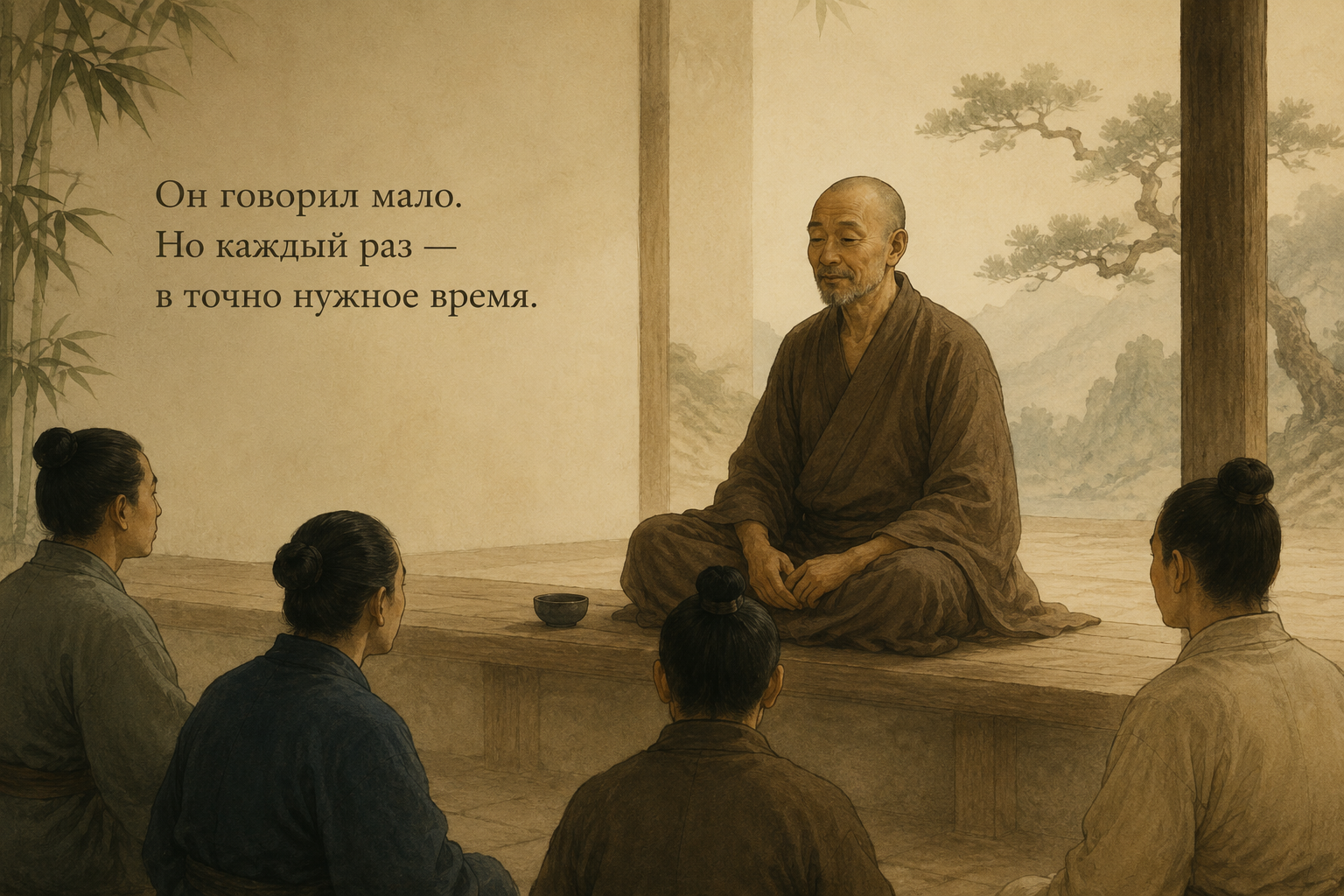
People said that he rarely explained more than was necessary. When students asked difficult questions, he did not hurry to build a system, decorate the answer with quotations, or turn the conversation into a lecture. Sometimes he simply remained silent. Sometimes he asked someone to bring tea. Sometimes he pointed to what the student had already seen but did not want to admit.
For those accustomed to searching for Dharma in great words, such a teacher could seem too simple. But in his presence it gradually became clear: simplicity does not mean poverty. Sometimes it is the sign that what is unnecessary has already fallen away.
His instruction appeared in small things. In the way he closed a door without letting it slam. In the way he listened to a person until the end. In the way he could pause before a bowl of water, as if seeing the reflection of light on its surface for the first time.
Students remembered that the hardest thing was not to understand his words, but to endure his attention. There was no pressure in that attention, yet it did not allow one to hide. Near him, a person began to notice their own haste, irritation, and desire to appear deeper than they were.
Such a master does not create noise around himself. He does not demand admiration or gather legends in advance. His presence works differently: it returns things to their true weight. A cup becomes a cup again. Breathing becomes breathing. The path is no longer an idea about awakening, but the next honest step.