Return to Nature: The Apple Orchard and the Longing for a Lost Centre
Returning to nature
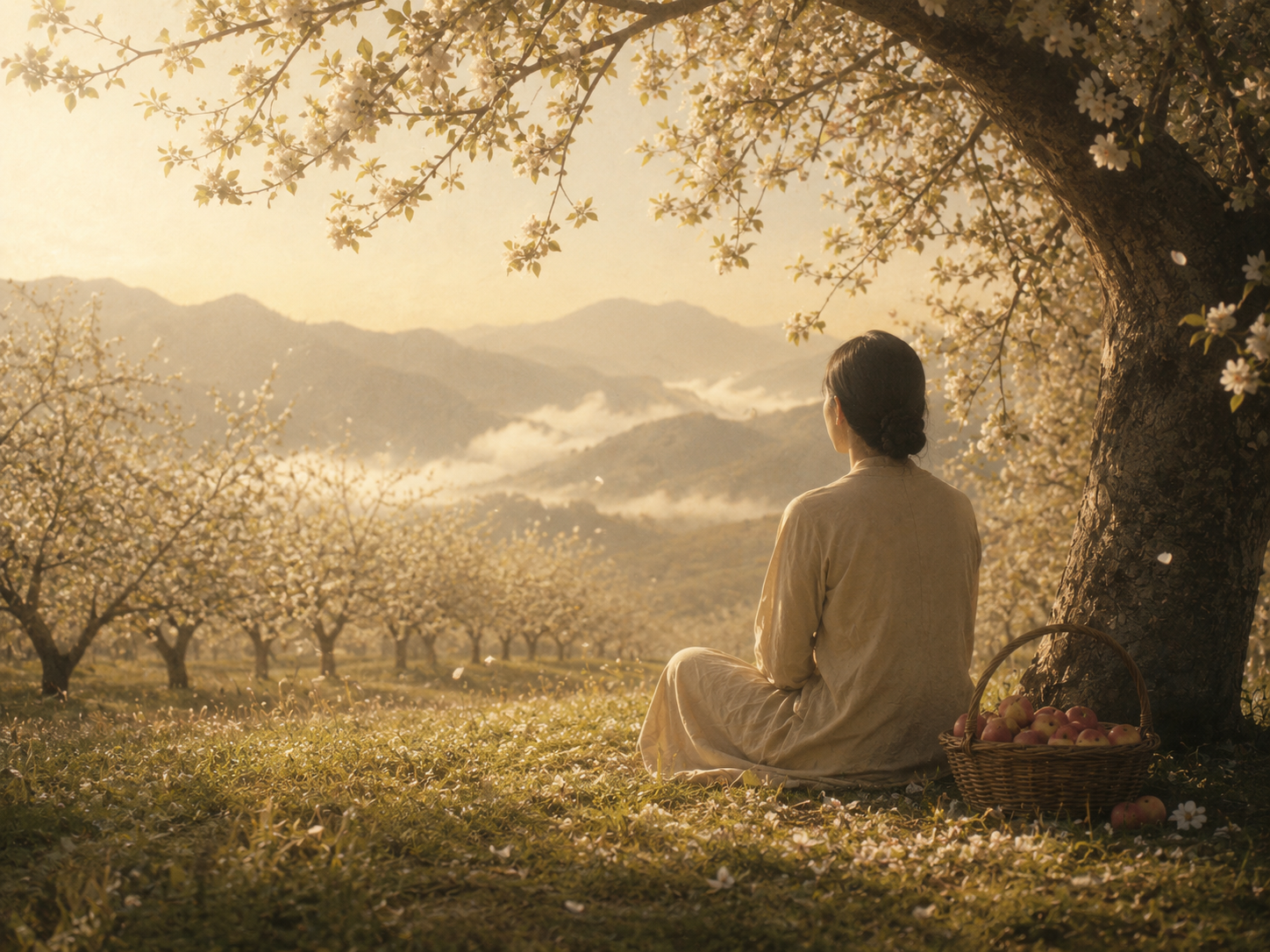
An apple orchard is a place where one can step away from agitation and enter the harmony of the natural world. It offers solitude and quiet, qualities that modern life so often lacks. The sound of leaves, birdsong, and the fragrance of blossoming apple trees help the body soften and the inner self open. To sit beneath the trees is already to let nature return us to a simpler form of presence.
Meditation beneath an apple tree
An apple orchard is an ideal place for meditation. It helps us attend to the breath, calm the mind, and feel harmony with ourselves. Listening to the leaves moving in the wind, we may sense that we are part of a wider natural symphony. With every inhalation and exhalation, we come closer to our own thoughts, feelings, and living presence.
Mindful presence
Presence in the moment is one of the foundations of meditation. Watching apple trees through the seasons, we see them awaken after winter, unfold their blossoms, become green, and later bear fruit. Each movement of the tree reveals the cycle of life and helps us feel our own place within it.
The longing for paradise and untouched nature
The modern longing for paradise and untouched nature is a nostalgia for a missing centre. We search intensely for something lost, often without knowing exactly what we are trying to find.
In a secular and technological society, the longing for paradise has lost its direct religious reference to Eden, but it has not disappeared. It has become a deep, often unconscious psychological and existential phenomenon: a desire for wholeness, serenity, perfect harmony, and authenticity in a world experienced as fragmented, alienated, and hyperreal.
This longing becomes a phantom limb of the modern psyche, appearing in many areas of life.
Philosophical and psychological roots
The idea of longing for paradise is rooted in philosophical anthropology. Mircea Eliade described homo religiosus as a being oriented toward a sacred Centre, a point of reference from which modern humanity has become estranged.
Sigmund Freud saw this desire as a projection of the unconscious wish to return to intrauterine bliss and unity with the mother.
Carl Jung interpreted paradise as an archetype of the Self: an inner wholeness lost through the development of ego.
In the modern context, other ideas also matter. Deleuze and Guattari wrote about the “schizophrenisation” of society, where capitalism produces desire but never allows it to reach fulfilment. This creates a permanent sense of loss. Bayard spoke of metaphysical nostalgia: not longing for a concrete past, but longing for a lost homeland of being.
Culture and everyday life
Today this longing often does not become prayer. It becomes compensatory practices promising to restore lost harmony.
The cult of nature and ecological utopianism connect paradise with untouched nature. From this arise downshifting, the dream of moving “closer to nature,” and the fetishisation of organic food and ecological materials: a desire for naturalness as purity before the fall, where industrialisation becomes the fall itself.
Apocalyptic narratives in art are the reverse side of the same longing: in order to return to a pure state, the world must first be cleansed of civilisation’s corruption.
Paradoxically, the longing for paradise is also projected into the technological future. Transhumanist projects promise immortality and new powers: a new Eden created through science. Virtual realities offer designed and controlled paradises without pain or the limits of physical life.
Social networks become spaces for curating an ideal self and an ideal life, a personal paradise narrative arranged for the gaze of others.
Consumerism turns the search for paradise into the cult of possession. Each purchase becomes a small attempt to fill an existential emptiness, a promise of a new beginning and a perfection that never arrives.
Paradise within
Modern people also search for paradise within themselves. Meditation, mindfulness, yoga, and psychotherapy are directed toward inner peace, toward a paradisal state of mind free from anxiety. Returning to the here and now becomes an image of the lost paradise of simple being.
Psychotherapy often works with trauma as an exile from the paradise of childhood safety, seeking integration: an inner wholeness that is the psychoanalytic analogue of paradise.
Nostalgia for a golden age
The longing for paradise appears in politics and art as well. Slogans about returning to former greatness exploit nostalgia for a lost paradise of national or social identity. Vintage and retro aesthetics search for paradise in the past, in warm, authentic, pre-digital forms.
The rise of fantasy and neo-mythology, from Tolkien to game worlds, creates alternative and coherent universes with clear laws of good and evil, something the complexity of modern life often lacks.
When longing becomes pathology
In extreme forms, longing for paradise can become destructive. Fear of missing out, depression through comparison, utopian sects, radical ideologies, addictions, and flight from reality may all be attempts not to live life, but to replace it with the image of a lost garden.
Yet the longing itself is not a mistake. It points to a memory of wholeness, to the human capacity to refuse the flatness of the world. The question is whether this longing becomes escape, or whether it becomes a path toward a more attentive, compassionate, and authentic life.